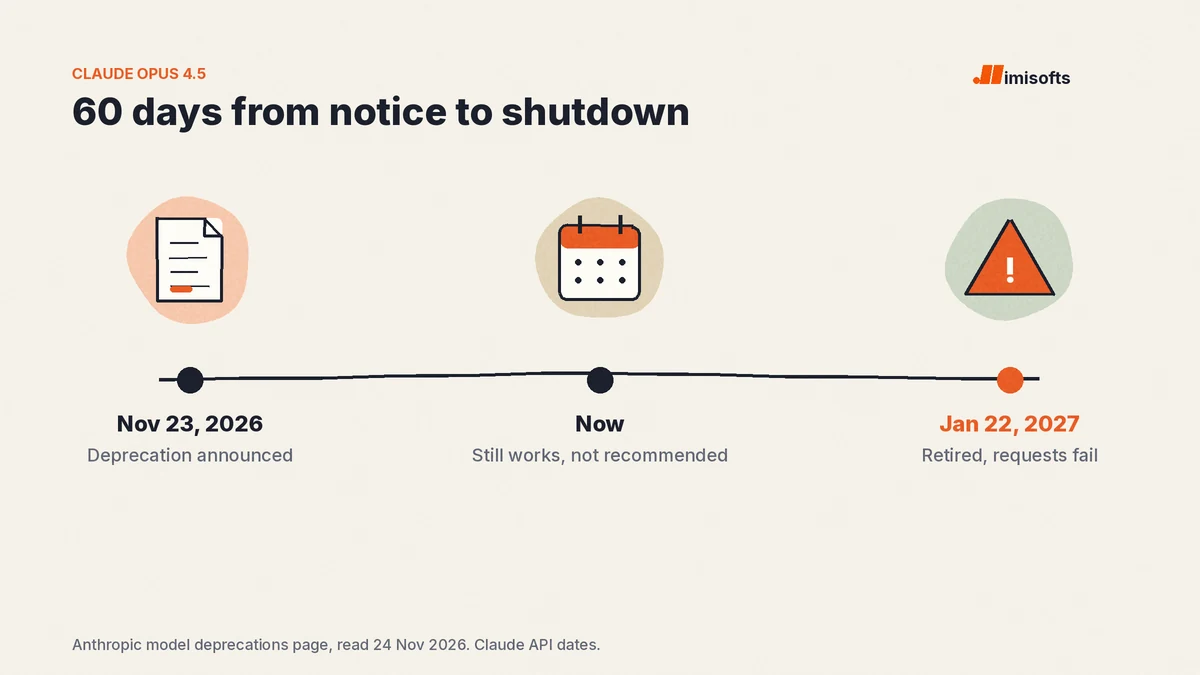
November 24, 2026. Anthropic will retire Claude Opus 4.5 on the Claude API on January 22, 2027, 60 days after it announced the deprecation on November 23. From that date, requests to claude-opus-4-5-20251101 and claude-opus-4-5 fail. The named replacement, Claude Opus 5.5, lists 20% lower token prices, $4 input and $20 output per 1M tokens against $5 and $25, but it may count up to about 35% more tokens for the same text. In our worked example the monthly bill for an AI SDR agent lands anywhere from 20% lower to 8% higher.
Key numbers
| Item | Number |
|---|---|
| Deprecation announced | November 23, 2026 |
| Retirement on the Claude API (requests fail after it) | January 22, 2027 |
| Notice period (Anthropic's stated minimum) | 60 days |
| Opus 4.5 price per 1M tokens | $5 in, $25 out |
| Opus 5.5 price per 1M tokens (20% lower) | $4 in, $20 out |
| Cache hits per 1M tokens (60% lower) | $0.50 to $0.20 |
| Token count on Opus 5.5 vs Opus 4.5 (newer tokenizer, varies by content) | 1x to 1.35x |
| Worked example, AI SDR agent per month (hypothetical, our arithmetic) | $250 to $200 or $270 |
Read on 24 November 2026 from Anthropic's release notes, model deprecations page, pricing page and Claude Opus 5.5 migration guide; the worked example is our arithmetic.
What Anthropic announced
The Claude Platform release notes entry dated November 23, 2026 reads: "We announced the deprecation of the Claude Opus 4.5 model (claude-opus-4-5-20251101 and claude-opus-4-5), with retirement on the Claude API scheduled for January 22, 2027. We recommend migrating to Claude Opus 5.5." The model deprecations page lists the same dates and the replacement claude-opus-5-5.
- Deprecated now. Anthropic's own definition: "The model is still functional but no longer recommended."
- Retired January 22, 2027. "The model is no longer available for use. Requests to retired models fail."
- Both model IDs. The retirement "includes claude-opus-4-5, the same model's ID without a date."
- Other clouds differ. The dates apply to Anthropic-operated platforms, including the Claude API and Claude Platform on AWS. For Amazon Bedrock, Claude Models on Google Cloud (Google managed) and Microsoft Foundry, the page points to its overview for the dates that apply.
- The minimum notice. Anthropic promises "at least 60 days' notice before model retirement for publicly released models." November 23 to January 22 is exactly 60 days.
Opus 4.5 and Opus 5.5 prices, per 1M tokens
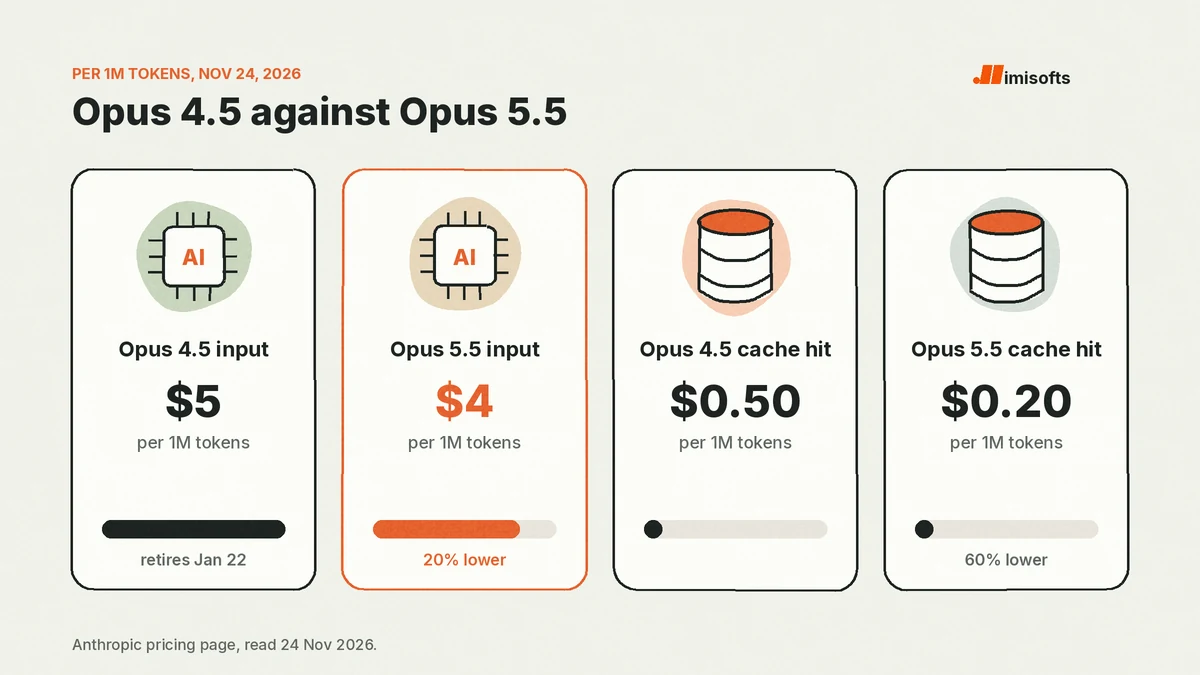
From Anthropic's pricing page, read on November 24, 2026:
| Item | Claude Opus 4.5 | Claude Opus 5.5 | Change |
|---|---|---|---|
| Input | $5 | $4 | 20% lower |
| Output | $25 | $20 | 20% lower |
| Cache write, 5 minutes | $6.25 | $5 | 20% lower |
| Cache write, 1 hour | $10 | $8 | 20% lower |
| Cache hits and refreshes | $0.50 | $0.20 | 60% lower |
The catch is in the Opus 5.5 migration guide. Opus 5.5 uses the tokenizer that arrived with Opus 4.7, which "might use roughly 1x to 1.35x as many tokens when processing text compared to models before Claude Opus 4.7". Opus 4.5 is one of those earlier models, so the same prompt can count up to about 35% more tokens.
Worked cost: an AI SDR agent on each model
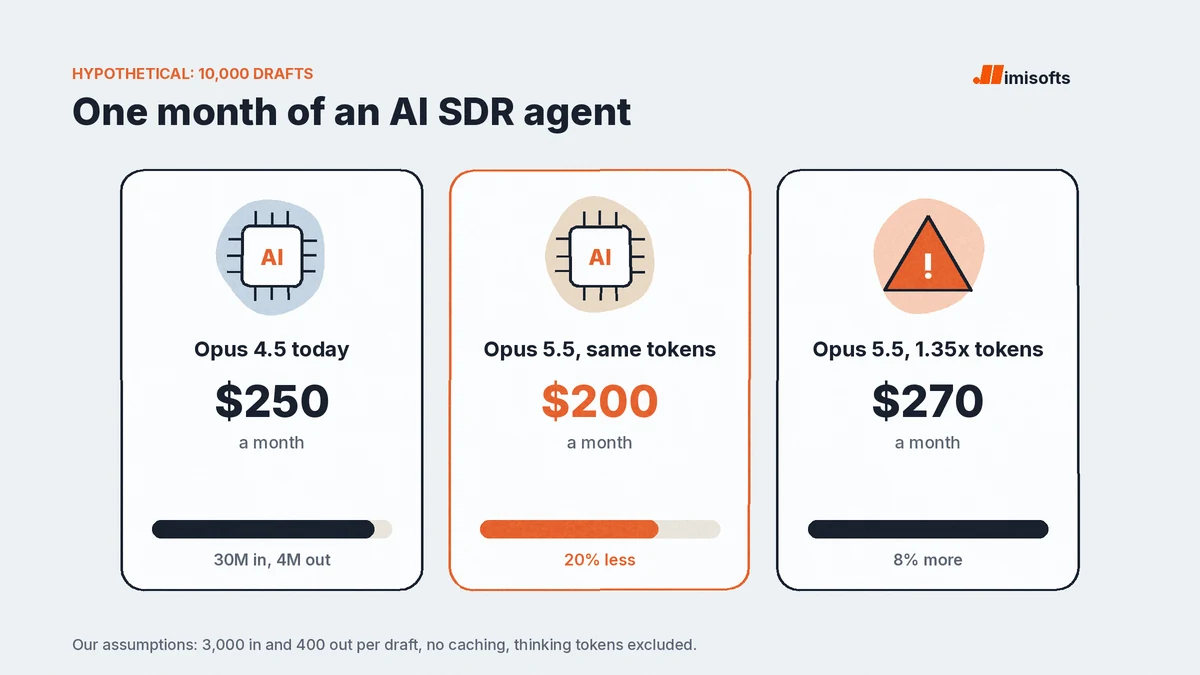
Our hypothetical: an outbound team's agent drafts 10,000 personalised emails a month. Each draft sends 3,000 input tokens (prospect research plus instructions) and returns 400 output tokens, counted on Opus 4.5, with no caching.
- Opus 4.5 today: 30M input tokens at $5 plus 4M output tokens at $25 is $250.00 a month.
- Opus 5.5, same token count: 30M at $4 plus 4M at $20 is $200.00, 20% less.
- Opus 5.5 at 1.35x tokens: 40.5M at $4 plus 5.4M at $20 is $270.00, 8% more: 80% of the old price on 1.35 times the tokens gives 1.08.
Two things move the real number. On Opus 5.5 adaptive thinking is always on (more below), and this example leaves thinking out. Caching helps: cache hits fall 60%, so an agent that reuses one long system prompt across drafts can save more on that part of the bill. The guide notes that /v1/messages/count_tokens returns a different number for Opus 5.5, so count your own prompts on both models before you budget. For a broader view of what agents cost to run, see our guide to AI chatbot costs for a business.
What breaks when you switch the model ID
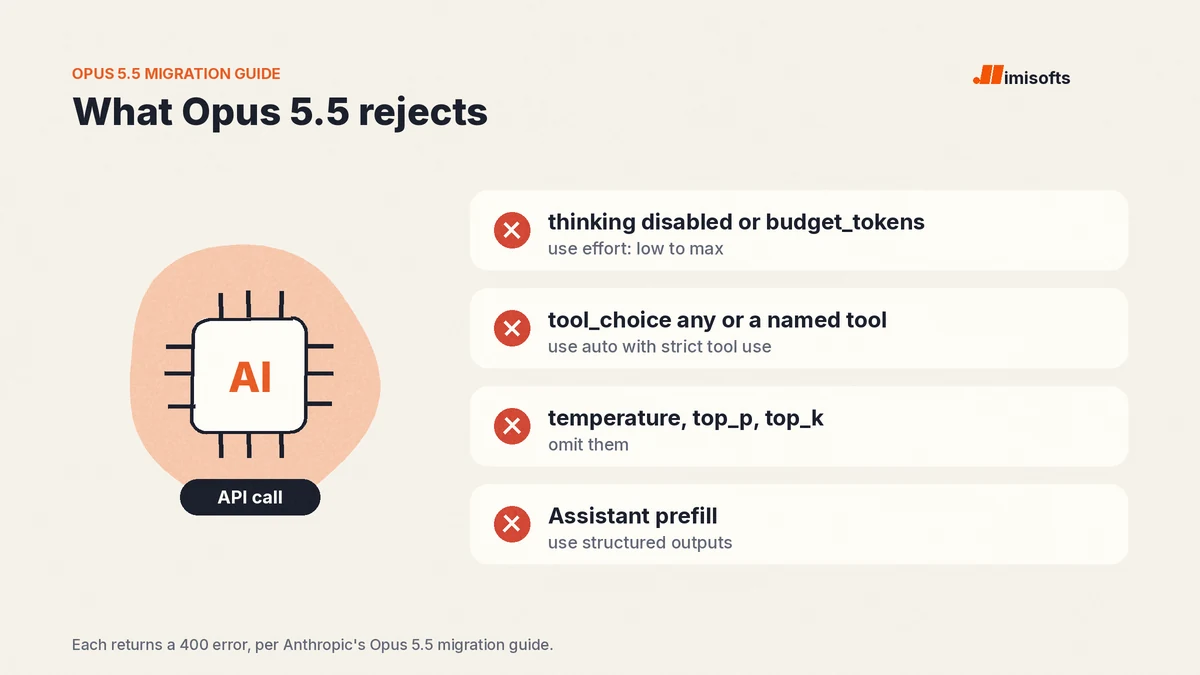
The migration guide lists request settings that Opus 5.5 rejects; where a setting is rejected, it says, the API returns a 400 error. The ones that hit agent code most often:
- Thinking cannot be turned off.
thinking: {"type": "disabled"}and manualbudget_tokensare rejected. Use theeffortparameter (low, medium, high, xhigh, max; default medium) instead. - No forced tool calls.
tool_choiceofanyor a namedtoolis rejected; useautowith strict tool use or structured outputs. - No sampling settings. Omit
temperature,top_pandtop_k. - No prefill. A message that ends with a prefilled assistant turn is rejected.
- Old beta headers go. For code written for Opus 4.5 the guide says to remove the
effort-2025-11-24andinterleaved-thinking-2025-05-14beta headers and moveoutput_formattooutput_config.format.
Voice agents feel the change too: a phone agent that relied on a forced tool call to book a meeting needs its prompt and tool setup rewritten. The phone agents on our AI calling for home services page and the email and CRM agents on our AI automation agency page are the kind of build to check. We covered an earlier retirement in our Claude Sonnet 4.5 retirement guide.
What to do before January 22, 2027
- Export usage by API key and model from the Usage page in Claude Console, as the deprecations page describes, to find every caller of Opus 4.5.
- Count tokens for your main prompts on Opus 5.5 and give
max_tokensmore headroom, as the migration guide advises. - Remove the rejected settings above, then test tool calls and output parsing on real traffic.
- Switch the model ID everywhere, including subagent definitions, before the date. From it, calls fail.
Frequently Asked Questions
On January 22, 2027 on the Claude API, per Anthropic's model deprecations page. Anthropic announced the deprecation on November 23, 2026. After retirement, requests to claude-opus-4-5-20251101 and claude-opus-4-5 fail.
Anthropic recommends Claude Opus 5.5, model ID claude-opus-5-5. It lists at $4 input and $20 output per 1M tokens, against $5 and $25 for Opus 4.5.
Per token, yes: input and output are 20% lower and cache hits 60% lower. But Opus 5.5 uses a newer tokenizer that may count roughly 1x to 1.35x as many tokens for the same text, so before caching and thinking a bill can fall by up to 20% or rise. In our worked example it ranged from $200 to $270 against $250 on Opus 4.5.
Not always. The migration guide says Opus 5.5 rejects disabled thinking, manual thinking budgets, forced tool choice, temperature, top_p, top_k and assistant prefill, and a rejected setting returns a 400 error. Change the model ID and remove those settings.
The date applies to Anthropic-operated platforms: the Claude API, Claude Platform on AWS and Claude Models on Google Cloud (Anthropic managed). For Amazon Bedrock, Google-managed Claude models on Google Cloud and Microsoft Foundry, Anthropic's deprecations page sends you to its overview, so check the date for your platform.