November 3, 2026. Riverside Payments, a Washington payment processor, its equipment-leasing affiliate Cascade Equipment Leasing and their owners will pay $600,000 to settle allegations by the Federal Trade Commission and Washington State that they promised small businesses savings that did not arrive and made it nearly impossible to cancel, the agencies announced on 2 November 2026. Under the proposed order, customers must be told they can rescind their processing agreements without a termination penalty for 60 days. In our view, the order reads as a list of what regulators treat as deceptive in a B2B pitch.
Key numbers
| Item | Number |
|---|---|
| Paid to settle with the FTC and Washington (announced 2 November 2026) | $600,000 |
| Judgment, suspended for inability to pay (due in full if finances were misrepresented) | $32,083,921 |
| Window to cancel without a termination penalty (start date not stated in the releases) | 60 days |
| Early termination fee in the contract (buried, per the complaint) | $695 |
| Savings Riverside at times claimed (switching customers typically paid more) | 40% to 60% |
| Length of the electronic contract (auto-renewal after a three-year term) | 26 pages |
| Agent earnings claimed in ads (a year; top agents "100k") | $75,000 to $95,000 |
| Average agent earnings, per the complaint (a year) | $3,787 |
| Washington businesses eligible for compensation (based on six months of volume) | more than 300 |
| Commission vote (complaint and stipulated order) | 2-0 |
FTC and Washington Attorney General releases of 2 November 2026, read on 3 November 2026.
What the FTC and Washington allege
According to the FTC and the Washington Attorney General, the complaint alleges:
- Savings that were not there. Quote sheets compared a merchant's current costs with Riverside's, and Riverside "at times claimed that small businesses could save 40% to 60% by switching". Businesses that switched "typically ended up paying more", the FTC says.
- Fees left off the quote. The sheets omitted "activation fees, batch fees and fees for supposed non-compliance with data security standards or inactive processing".
- Terms buried in the contract. A 26-page electronic contract held automatic renewal after the initial three-year term, a $695 early termination fee and an equipment lease from Cascade that ran one year longer than the processing contract.
- A cancellation loop. Riverside falsely promised businesses they could cancel anytime without penalty and falsely claimed it would switch unhappy customers back and pay them $500 for their "time and hassle", the FTC says. Instead, according to the complaint, they were left in a "complicated loop of deflection and fruitless phone calls".
The FTC alleges violations of the FTC Act, and of the Gramm-Leach-Bliley Act by obtaining consumers' financial information through false or fraudulent statements; Washington alleges violations of its Consumer Protection Act. The complaint and a stipulated final order were filed in the U.S. District Court for the Western District of Washington, and the FTC notes such orders have the force of law once a judge signs them.
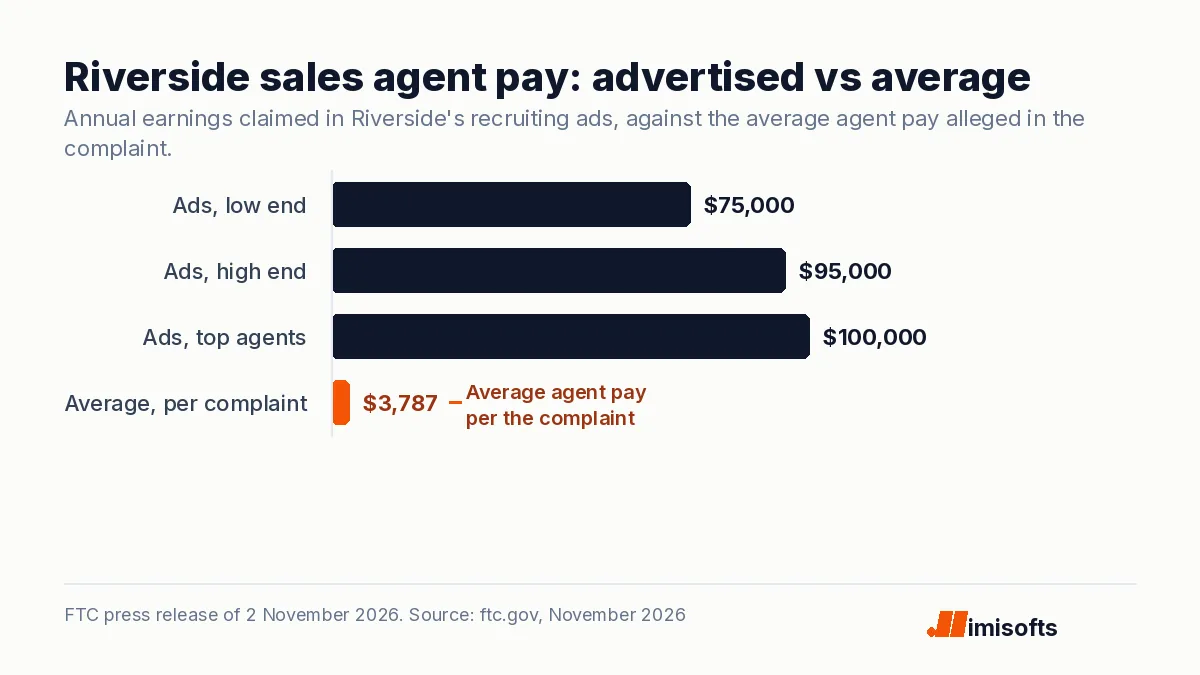
The earnings claims used to recruit sales agents
Riverside's sales agents work on commission. Its ads claimed they "could earn between $75,000 and $95,000 a year, and that top sales agents can make '100k'" ($100,000). According to the complaint, agents made $3,787 a year on average, about one twentieth of the low end of the advertised range.
What the order requires
The proposed order would impose a $32,083,921 judgment, suspended after the $600,000 payment because of the defendants' inability to pay; the full amount will be due if they are found to have misrepresented their finances. It would bar the defendants from misrepresenting costs, savings or cancellation terms, from unsubstantiated savings and earnings claims, and from misrepresenting any negative option feature. It would require disclosure of all material terms before taking billing information, express informed consent to a negative option plan and "a simple way to cancel". In Washington, more than 300 small businesses will be eligible for compensation based on their processing volume over the past six months. The Commission vote was 2-0.
What it means for operators
If you process cards with Riverside, watch for the notice of the 60-day window before deciding whether to stay. If you sell to small businesses, the order binds only these defendants, but in our view its terms work as a checklist for any B2B sales script:
- Put every fee the customer will pay on the savings quote, and keep the basis for any savings figure.
- Show renewal terms, termination fees and any equipment lease before you take billing details.
- If you say customers can cancel anytime, give them a working way to do it.
- Back earnings claims in recruiting ads with what reps actually earn on average.
In our view, agencies that resell software on monthly plans face the same renewal and cancellation questions; see our GoHighLevel white-label SaaS service and SaaS launch work. For a related case, read the FTC's case against Toast over fees and cancellation; for commission-based outbound staffing, see outsourced SDR. This is general information, not legal advice.
Frequently Asked Questions
Announced on 2 November 2026, it would resolve FTC and Washington State allegations that Riverside Payments, Cascade Equipment Leasing and their owners deceived small businesses about payment-processing savings, fees and cancellation. They will pay $600,000; under the proposed order a $32,083,921 judgment is suspended because of inability to pay, and the defendants are barred from the alleged practices.
The proposed order requires the defendants to notify customers that, for a 60-day period, Riverside will waive the early termination fee or any penalty for rescinding the merchant-processing agreements. Watch for that notice.
Washington's Attorney General says more than 300 small businesses in Washington will be eligible for compensation based on each business's processing volume over the past six months. The FTC's release does not describe a refund process for businesses in other states.
The complaint alleges Riverside at times claimed savings of 40% to 60% while switching customers typically paid more, left fees off its quotes, buried auto-renewals, a $695 termination fee and equipment leases in a 26-page contract, made cancelling nearly impossible, and advertised $75,000 to $95,000 a year for commission agents who averaged $3,787.