Affiliate disclosure: some links in this article are partner links. If you start a paid plan through them, imisofts may earn a commission at no extra cost to you. We only recommend tools we actually use to run client campaigns.
Short answer. Neither the FCC rule nor the FTC rule we read bans parallel dialing, but FCC rules decide how you run it: 47 CFR 64.1200(a)(6) bars disconnecting an unanswered telemarketing call before 15 seconds or four rings, (a)(7) caps abandoned calls at 3% of calls answered live per campaign in each 30-day period (a call is abandoned if no live sales rep is on within two seconds of the completed greeting), and (a)(5) bars using an autodialer in a way that ties up two or more lines of one multi-line business at once. Close's Predictive Dialer abandons an answered call when no rep is free, and Apollo puts its parallel dialer's latency at about three seconds with voicemail drops on, start point not stated. The FCC asked in October 2025 whether to delete the 15-second and 3% rules; the eCFR current to 30 October 2026 still has them.
We earn a commission if you buy Close or Apollo through our links; Orum, Nooks and the regulators pay us nothing. We read the rules and vendor pages linked below on 3 November 2026. This is general information, not legal advice; state laws, penalties and lawsuits are out of scope. For the abandonment rule itself, message wording included, see our TCPA abandonment rate guide.
Key numbers
| Item | Number |
|---|---|
| FCC minimum ring before hanging up (47 CFR 64.1200(a)(6), for unanswered telemarketing calls) | 15 seconds or 4 rings |
| FCC cap on abandoned calls (per calling campaign in each 30-day period, (a)(7)) | 3% of calls answered live |
| Time to connect a live sales rep (after the called person's completed greeting, (a)(7)) | 2 seconds |
| FCC 25-76 reply comments due (rules still in the eCFR current to 30 October 2026) | 3 February 2026 |
| Apollo parallel dialer latency, voicemail drops on (start point not stated; significantly reduced without drops, per Apollo's FAQ) | about 3 seconds |
| Apollo lines dialed at once (per Apollo's help center) | 3 recommended, up to 5 |
| Orum's own parallel dialing (at roughly a 5% connect rate, per Orum's help center) | 4 to 5 numbers at a time |
| Close Power Dialer default ring (20 seconds with Reduced Ring Time on both dialers; Predictive default not stated) | 32 seconds |
| Close Scale plan (Predictive Dialer) (billed yearly; $149 billed monthly) | $139 per user a month |
| Close Growth plan (Power Dialer only) (billed yearly; $109 billed monthly) | $99 per user a month |
| Close Scale over Growth, per rep (seat price on either billing cycle, before call charges) | $480 a year |
| Apollo Advanced Dialer add-on (billed annually; $149 billed monthly; on top of a paid plan; labelled introductory) | $119 per team a month |
Rules read on 3 November 2026 on eCFR (current to 30 October 2026) and in the Federal Register; Close and Apollo prices from their pricing pages, and dialer figures from the Close, Apollo and Orum help centers, the same day.
What a parallel dialer does, in the vendors' words
- Parallel dialer. Orum: "Parallel dialing is calling multiple numbers at once"; reps "will not hear the phone ring or the prospect's initial greeting". Nooks, in its section on a prospect who doesn't answer: "When one line connects, Nooks hangs up the other lines. Those cancelled calls are not logged, don't count as dials, and stay in your list to be called later." Apollo: its parallel dialer "calls multiple contacts at the same time and connects you to the first person who answers".
- Predictive dialer. Close's Predictive Dialer "calls several Leads in a Smart View at the same time", and Close defines an abandoned call as "one a Lead answers when no user is free to take it."
- Power dialer. Close describes one that "dials a phone number right after a call is completed". With one line per rep, a rep is normally on the line when someone answers: lower risk, not no risk.
The FCC rules at issue for parallel dialers
The eCFR text of 47 CFR 64.1200 says no person or entity may:
- (a)(5): "Use an automatic telephone dialing system in such a way that two or more telephone lines of a multi-line business are engaged simultaneously." The rule defines an autodialer as equipment with "the capacity to store or produce telephone numbers to be called using a random or sequential number generator and to dial such numbers".
- (a)(6): "Disconnect an unanswered telemarketing call prior to at least 15 seconds or four (4) rings."
- (a)(7): "Abandon more than three percent of all telemarketing calls that are answered live by a person, as measured over a 30-day period for a single calling campaign." A call is abandoned "if it is not connected to a live sales representative within two (2) seconds of the called person's completed greeting", and when no rep is free the seller or telemarketer must provide a prerecorded identification message plus an automated voice or key-press opt-out. The seller or telemarketer "must maintain records establishing compliance with paragraph (a)(7)", and calls by or for tax-exempt nonprofits are not covered.
On our reading, five points follow for a parallel dialer. (a)(5) matters only if the dialer meets that definition; Nooks says its dialer does not, and the Orum, Apollo and Close dialer pages we read do not say. A ringing line cancelled before 15 seconds or four rings because another line connected is the disconnect (a)(6) describes; none of the parallel dialer pages we read says how long a line rings first. A second person who answers and is cancelled is an abandoned call for the 3% count, owed the message and opt-out within two seconds of the completed greeting. A hand-off that ends more than two seconds after the completed greeting makes the call abandoned even though a rep picks up: Apollo's FAQ says "The latency is approximately three seconds if you use a voicemail drop. If you don't use voicemail drops, latency is significantly reduced", without saying whether those seconds start at the pickup or at the end of the greeting, and Orum and Nooks give no figure. And because the records duty sits with the seller or telemarketer, ask what your dialer logs about answered calls it drops; none of the Orum, Nooks or Apollo pages we read says.
The ring times Close states are above 15 seconds: its Power Dialer article gives a 32-second default and a 20-second Reduced Ring Time that "applies to both the Power and Predictive Dialers". Neither Close article gives the Predictive Dialer's default or says whether it cancels lines still ringing when one connects, so ask Close too.
The FCC asked whether to delete the 15-second and 3% rules
On 28 October 2025 the FCC adopted FCC 25-76, published in the Federal Register on 5 December 2025. Paragraph 75 says: "We seek comment on whether to eliminate our rules prohibiting callers from disconnecting an unanswered telemarketing call prior to at least 15 seconds or four rings, and from abandoning more than three percent of all telemarketing calls." Paragraph 76 says the rules were adopted in 2003 against silence and hang-ups caused "largely as a result of the predictive dialers callers used at the time", and that today's predictive dialers, which "appear to leverage advances in technology, including Artificial Intelligence", along with marketers' incentives to avoid dead air and abandoned calls, "may mean our rules are no longer necessary."
Comments were due by 5 January 2026 and replies by 3 February 2026. Asking for comment is not a rule change: on 3 November 2026 the eCFR, current to 30 October 2026, still contained (a)(6) and (a)(7), and the latest amendment to 64.1200, FCC 26-67 (Federal Register, 26 October 2026), revises other paragraphs. We found no order deleting them. If they were deleted, the FTC's Telemarketing Sales Rule would keep its own abandonment rule and safe harbor (16 CFR 310.4), but it exempts most business-to-business calls.
What Close, Orum, Nooks and Apollo document
| On the pages we read | Close predictive | Orum parallel | Nooks parallel | Apollo parallel |
|---|---|---|---|---|
| When one line connects | Not on the pages we read | "all other calls will be canceled" | "hangs up the other lines" | "stops dialing other contacts" |
| Extra answers | Hear your abandonment message | First detected connects, "canceling on the other calls" | Not on the pages we read | First to answer connects; "automatically disconnects the remaining calls" |
| Delay before a rep is connected | Not on the pages we read | No figure; transferred "once the AI has determined you're live" | No figure | "approximately three seconds" with voicemail drops; start point not stated |
| Abandoned-call message and automated opt-out | Message with your name and a number; no automated opt-out on the pages we read | Not on the pages we read | Not on the pages we read | Not on the pages we read |
| 3% figure or target rate | Not on the pages we read; abandonment rate is a pacing input | Not on the pages we read | Not on the pages we read | Not on the pages we read |
| Ring time | 20 seconds with Reduced Ring Time (both dialers); predictive default not stated | Not on the pages we read | Not on the pages we read | Not on the pages we read |
| Lines at once | Set by the dialer | Orum's own team: 4 to 5 | 1 to 2 at first, 5 as a goal | 3 recommended, up to 5 |
| Turn multi-line dialing off | Use the Power Dialer (one line) | Set the maximum to 1 | 1 simultaneous dial (implied by its page); 1 to 2 at first | Use the power dialer (one at a time) |
"Not on the pages we read" covers Close's two dialer articles, Orum's article ("Updated last year") and its Compliance section (one article, on number spoofing), Nooks' article and US compliance guide, and Apollo's dialing article ("Updated 2 months ago"); it does not mean a product lacks the feature. Nooks' guide says "Nooks is not considered an ATDS", giving as one reason that Nooks "does not utilize a random or sequential number generator". Apollo's article tells users to learn the TCPA and "seek consent to call prospects if required", and does not mention abandoned calls. On our reading, (a)(6) and (a)(7) apply whatever the equipment; ATDS status matters for (a)(5) and for the consent rules in (a)(1) and (a)(2). For prices and features, see our cold calling software comparison.
What Close and Apollo dialers cost, and the gaps
Close and Apollo pay us, so here are their numbers, including the ones that cost you more. Close: "The Predictive Dialer is available on the Scale plan. The Growth plan includes the Power Dialer but not the Predictive Dialer."
| Close plan | Dialer | Billed yearly | Billed monthly | Per rep a year, yearly billing |
|---|---|---|---|---|
| Growth | Power Dialer | $99 | $109 | $1,188 |
| Scale | Power and Predictive Dialer | $139 | $149 | $1,668 |
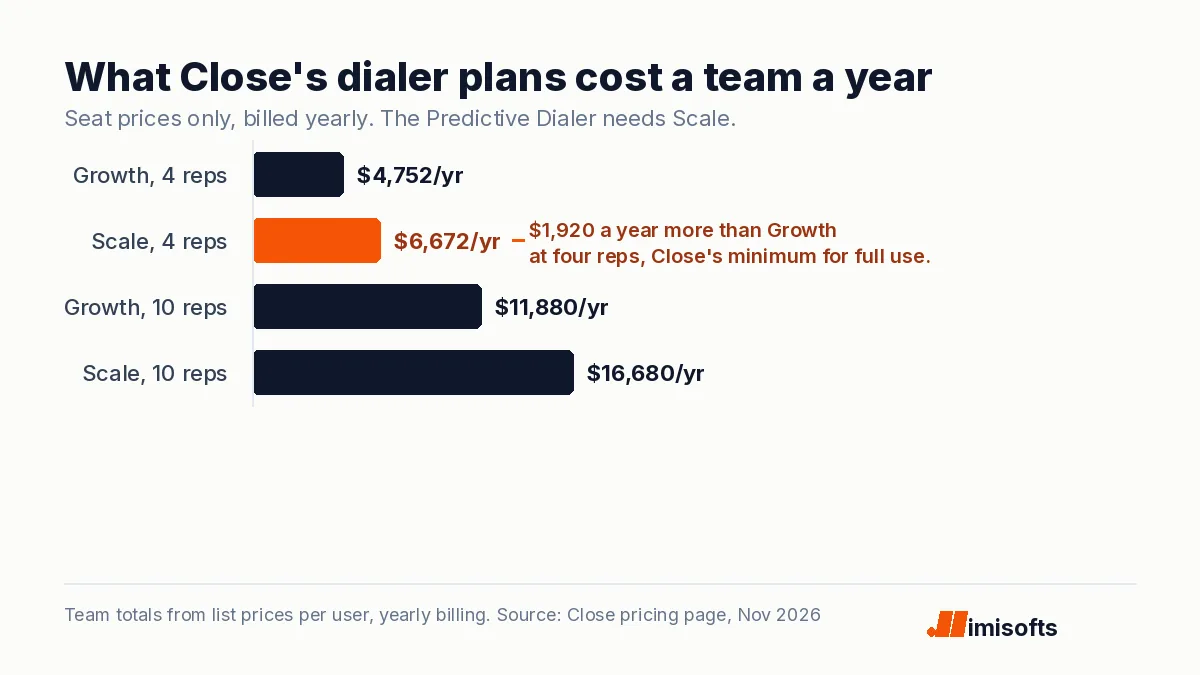
Prices are per user per month on Close's pricing page on 3 November 2026, and calls are extra: "Calling and SMS usage fees are not included in plan costs", with "most outbound calls around $0.02/minute." Scale costs $480 more per rep per year on either billing cycle. Close says you "should have at least 4 people logged in" to use the Predictive Dialer fully, calls "10 and over" optimal, and says that if "you're dialing alone (or with a very small team), the Predictive Dialer is less effective". On yearly billing, seats for four reps cost $4,752 a year on Growth and $6,672 on Scale ($1,920 more); for ten reps, $11,880 and $16,680 ($4,800 more).
The gaps, on our reading. Close's definition of an abandoned call ("when no user is free") has no two-second test, so ask how its rate lines up with the FCC's. Close requires a message that "must include: Your organization's name" and "A phone number the Lead can call"; its sample does both but does not say "telemarketing purposes", which the FCC's (a)(7)(i)(A) requires, and adds lines such as "due to a technical error" that the FCC list does not include. Close's article also describes no automated voice or key-press opt-out, which (a)(7)(i)(B) requires, and we found none in its help-center index on 3 November 2026. You record your own message, so the wording is fixable; ask Close about the opt-out before you switch predictive mode on for sales calls.
Apollo: "Parallel and power dialing require the advanced dialer add-on for your Apollo plan." Its pricing page lists that add-on at $119 per team per month billed annually or $149 monthly, on top of a paid plan (Basic is $49 per seat a month billed annually), calls the prices introductory and marks its US dialer "credits apply". Four reps on Basic come to $2,352 in seats plus $1,428 for the add-on, $3,780 a year before calling credits; Apollo bundles prospect data and Close is a CRM, so we do not rank the two on price. The open questions for Apollo: where its "approximately three seconds" starts, measured against a two-second window, and what message and opt-out a disconnected answer gets, since the pages we read describe neither.
For smaller teams we see a power dialer as the lower-risk option for both rules. Compare Close's Growth and Scale plans (partner link), or see our Close CRM pricing breakdown. If you already prospect in Apollo, see Apollo's plans and the Advanced Dialer add-on (partner link), and time the hand-off before you raise the line count.
B2B calls, AI voices and the consent rules
The FTC's version of the abandonment rule sits in its section on abusive telemarketing acts or practices, and 310.6(b)(7) exempts "Telephone calls between a telemarketer and any business to induce the purchase of goods or services or a charitable contribution by the business", except retail sales of nondurable office or cleaning supplies and the requirements of 310.3(a)(2) and (4). The FCC's (a)(6) and (a)(7) list no B2B exemption, and the FCC defines telemarketing as a call made to encourage a purchase, rental or investment that "is transmitted to any person", so on our reading they reach B2B sales calls too; we found no FCC statement saying so. One point cuts against that reading: the FCC says the DNC Act required it to "maximize consistency" with a portion of the FTC's rule.
If an AI voice picks up the answered call, the FCC's ruling FCC 24-17, released on 8 February 2024, says the TCPA's limits on "artificial or prerecorded voice" "encompass current AI technologies that generate human voices", so, on our reading of (a)(2) and (a)(3), prior express written consent applies to sales calls to wireless numbers and residential lines unless an exception applies. Our practice: we would not count an AI hand-off as a live connection. Our page on AI calling built around TCPA consent describes the consent, suppression and opt-out layer we build under an AI dialer; see also AI calling for home services, the AI voice agents comparison and the HVAC answering service guide.
Questions to settle before you run a parallel dialer
- How long does a line ring before it is cancelled when another line connects? The FCC's floor is 15 seconds or four rings.
- How fast is the hand-off? Call a test phone, say hello and count; on our reading, no rep within two seconds of the completed greeting means an abandoned call. Apollo puts its latency at about three seconds with voicemail drops on (start point not stated) and says it is "significantly reduced" without them.
- Is the dialer an autodialer under the FCC's definition? If it is, (a)(5) bars tying up two or more lines of one multi-line business at once.
- What does a second person who answers hear, and is that call logged? On our reading, it counts toward the 3%.
- Does the abandoned-call message match the FCC's list, with an automated voice or key-press opt-out?
- Our suggestion for small teams: a power dialer, or few parallel lines (Orum turns parallel dialing off at a maximum of 1; Nooks suggests 1 to 2 lines at first). Fewer lines cut double answers; they do not settle the ring-time or two-second questions.
- Also check telemarketing laws by state, the reassigned numbers database and the TCPA opt-out requirements, where the FCC's consent revocation changes take effect on 25 November 2026. Outside the US, see cold calling laws in Canada and South Africa.
If a power dialer fits your team, try Close and test the Power Dialer on Growth (partner link). This is general information, not legal advice.
Frequently Asked Questions
Neither the FCC rule nor the FTC rule we read bans parallel dialing, but the FCC's 47 CFR 64.1200 sets two limits that, on our reading, apply to it: (a)(6) bars hanging up on an unanswered telemarketing call before 15 seconds or four rings, and (a)(7) caps abandoned calls at 3% of calls answered live per campaign in each 30-day period, counting a call as abandoned if no live sales rep is on within two seconds of the completed greeting. If the dialer is an automatic telephone dialing system, (a)(5) also bars using it in a way that ties up two or more lines of one multi-line business at once, and calls to wireless numbers need consent under (a)(1) and (a)(2); we did not review whether any product is one. This is general information, not legal advice.
Close describes a power dialer as one that dials the next number right after a call is completed. Close's Predictive Dialer calls several leads at the same time and connects you only when a person answers; when a lead answers and no user is free, the call is abandoned and the lead hears an abandonment message. A parallel dialer such as Orum, Nooks or Apollo's calls several numbers at once, connects one answered call to the rep and cancels, hangs up or disconnects the other calls, in each vendor's own words.
The FCC's rule at 47 CFR 64.1200(a)(6) covers unanswered telemarketing calls. On our reading, it applies whatever the dialer, B2B sales calls included, and a parallel dialer that cancels a ringing line before 15 seconds or four rings because another line connected is making the disconnect the rule bars; we found no FCC statement saying so. None of the Orum, Nooks or Apollo help pages we read says how long a line rings before it is cancelled.
Orum says it connects the first person it detects and cancels the other calls, and calls the chance incredibly low based on connect rates but likelier at high connect rates with 10 lines. Apollo says it connects the first prospect who answers and automatically disconnects the remaining calls. On our reading, the disconnected person's call is abandoned under the FCC's rule, counts toward the 3% cap and is owed the message and opt-out within two seconds of the completed greeting. A slow hand-off can also make an answered call abandoned; Apollo puts its own latency at about three seconds with voicemail drops on, without saying when that clock starts.
The FCC asked in FCC 25-76, adopted on 28 October 2025, whether to eliminate the 3% cap and the 15-second ring rule; reply comments were due by 3 February 2026. On 3 November 2026 the eCFR, current to 30 October 2026, still contained both rules, and we found no order deleting them. The FTC's rule has a similar safe harbor but exempts most business-to-business calls.
Close puts its Predictive Dialer on Scale, at $139 per user a month billed yearly or $149 billed monthly; Growth, at $99 or $109, has the Power Dialer but not the Predictive Dialer, so moving to Scale costs $480 more per rep per year before call charges. Apollo puts parallel and power dialing in its Advanced Dialer add-on, $119 per team a month billed annually or $149 billed monthly, on top of a paid plan, and labels its prices introductory. The two products differ: Apollo bundles prospect data, and Close is a CRM. Prices read on 3 November 2026 on each vendor's pricing page.