Affiliate disclosure: some links in this article are partner links. If you start a paid plan through them, imisofts may earn a commission at no extra cost to you. We only recommend tools we actually use to run client campaigns.
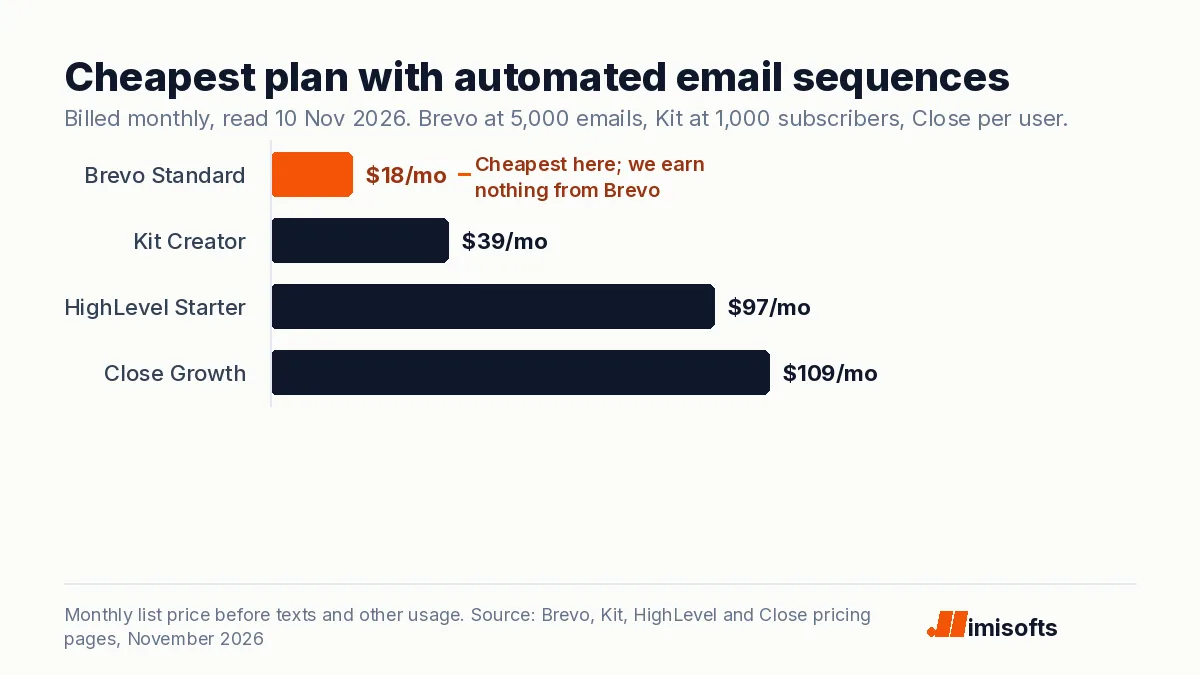
Short answer. We suggest running lead nurturing email automation as one sequence that starts the minute an inquiry arrives and stops the moment the lead replies. In research reported in Harvard Business Review in March 2011, firms that tried to contact a lead within an hour were "nearly seven times as likely to qualify the lead" as those that tried "even an hour later." Billed monthly, the cheapest plan with automated email sequences on each vendor's own page on 10 November 2026 was $18 a month on Brevo (at 5,000 emails a month), $39 on Kit (at 1,000 subscribers), $97 on HighLevel and $109 per user on Close, its cheapest plan with Workflows.
Below: the 14-day sequence we suggest, what changes for a cold email reply, the federal rules on opt-outs and calling hours, and what a hypothetical 300 inquiries a month cost on HighLevel and Close. We earn a commission from HighLevel, Close and Kit, and nothing from Brevo.
Key numbers
| Item | Number |
|---|---|
| Firms that tried a lead within an hour (HBR, 2011) (against firms that tried an hour later; 1.25 million leads) | Nearly seven times as likely to qualify it |
| Companies that never answered a test lead (HBR) (of 2,241 US companies audited) | 23% |
| Brevo Standard, billed monthly (at 5,000 emails a month; adds marketing automation; we earn nothing from Brevo) | $18 a month |
| Kit Creator at 1,000 subscribers, billed monthly ($468 over a year, or $390 paid yearly; Kit's table lists no automated sequences on Free) | $39 a month |
| HighLevel Starter, listed price (email, SMS and a Call action in workflows; usage extra) | $97 a month |
| Close Growth, cheapest Close plan with Workflows (billed monthly; $99 per user a month billed yearly) | $109 per user a month |
| HighLevel US text, per segment (plus an outbound carrier fee of $0.0035 to $0.0050) | $0.00747 |
| HighLevel email sending (all plans) | $0.675 per 1,000 emails |
| 300 inquiries a month on HighLevel (hypothetical) (5 emails and 3 texts per lead; range set by carrier and campaign fees) | $110.54 to $120.89 a month |
| Same volume on Close Growth, one user (billed monthly, before a phone number and any carrier fees) | $117.97 to $119.50 a month |
| Deadline to honor an email or text opt-out (CAN-SPAM, and 47 CFR 64.1200(a)(10) for texts) | 10 business days |
| Federal window for telephone solicitation calls (residential subscribers, local time; 47 CFR 64.1200(c)(1)) | 8 a.m. to 9 p.m. |
Prices and rules read on 10 November 2026 from the Brevo, Kit, HighLevel, Close and Twilio pricing and help pages, the FTC CAN-SPAM guide, the FCC and 47 CFR 64.1200 on eCFR; HBR figures from research published in March 2011, as quoted by SmartCompany.
Why the first hour sets the sequence
The timing evidence we use is The Short Life of Online Sales Leads (Oldroyd, McElheran and Elkington, HBR, March 2011), as quoted by SmartCompany. The authors audited 2,241 US companies with a web test lead: "37% responded to the lead within an hour, and 16% responded within one to 24 hours, 24% took more than 24 hours" and "23% of the companies never responded at all." A separate study in the same article covered 1.25 million leads at 29 B2C and 13 B2B companies in the US, and found the within-an-hour firms "nearly seven times as likely to qualify the lead (which we defined as having a meaningful conversation with a key decision maker)" as those that tried "even an hour later."
The study is from 2011 and measured attempts to contact, not automated emails. What it supports is the order of the sequence: the first touches belong in the first hour, and automation is how a small team gets them out at 7 p.m. on a Saturday. Our speed to lead guide covers response time on its own.
A 14-day nurture sequence after an inquiry
This is our suggestion, not a benchmark. We found no independent study that settles how many touches convert best, so treat the timings as a starting point to test against your own replies.
| When | Channel | What to send |
|---|---|---|
| Minute 0 | Confirm the inquiry, say who will call and when, add a booking link | |
| Minute 0 | Text, only with text consent | One line with your business name, the call time and "reply STOP to opt out" |
| First hour | Call by a person | Answer the question and book the visit, quote or demo |
| Day 1 | The answer to what they asked, with a price range or the next step | |
| Day 2 | Call by a person | Second attempt if there is no reply |
| Day 3 | Text | A short check-in with the booking link |
| Day 5 | One piece of proof, such as a short case or a before and after | |
| Day 7 | Text | One question: still looking, or sorted? |
| Day 8 | Call by a person | Third and last call attempt |
| Day 10 | The usual objection (price, timing or trust) and your answer | |
| Day 14 | Close the loop: "Should I close your file?" |
That is 5 emails, 3 texts and 3 call attempts over 14 days. Every step after the first is skipped once the lead replies or books; the section on stopping the sequence shows how two tools do that. A call placed with an AI-generated or prerecorded voice instead of a person falls under the consent rule in the rules section below.
What changes when the lead is a cold email reply
A reply to a cold email is a conversation by email, so we keep it there: a person answers within the hour, and the automated part is a short email follow-up if the thread goes quiet. When those follow-ups are commercial, the federal email rules apply: the FTC's CAN-SPAM guide says the law covers "any electronic mail message the primary purpose of which is the commercial advertisement or promotion of a commercial product or service" and "makes no exception for business-to-business email."
Texts are where we would stop and check consent first. On our reading, a reply such as "tell me more" is not the "prior express written consent" that the FCC rule asks for before marketing calls made with an autodialer or an artificial or prerecorded voice, and the rule's opt-out paragraph treats texts as made under the same paragraphs. Whether a texting tool counts as an autodialer is its own question, covered in our TCPA autodialer guide. Ask for the number and the permission in the email thread, and record both. This is general information, not legal advice.
The rules that set send times and stop points
For email, the FTC's CAN-SPAM guide, read on 10 November 2026, lists the parts that shape a nurture sequence: "Your message must include your valid physical postal address," and "You must honor a recipient's opt-out request within 10 business days." It also says "Each separate email in violation of the CAN-SPAM Act is subject to penalties of up to $53,088." Our CAN-SPAM penalties guide has the detail.
For calls and texts, 47 CFR 64.1200 does four jobs in this sequence:
- Consent. Paragraph (a)(2) bars marketing calls "using an automatic telephone dialing system or an artificial or prerecorded voice" to numbers that include any "assigned to a paging service, cellular telephone service" without "the prior express written consent of the called party", apart from exceptions for tax-exempt nonprofits and some health care messages.
- Texts. Paragraph (a)(10) covers consent "to receive calls or text messages made pursuant to paragraphs (a)(1) through (3)", which on our reading puts marketing texts under the same consent rule.
- Opt-outs. The same paragraph treats a reply of "stop," "quit," "end," "revoke," "opt out," "cancel," or "unsubscribe" as a valid revocation, which "must be honored within a reasonable time not to exceed ten business days."
- Hours. Paragraph (c)(1) bars telephone solicitation to "[a]ny residential telephone subscriber before the hour of 8 a.m. or after 9 p.m. (local time at the called party's location)." We keep texts inside the same window too; that is our practice, not the rule's text.
The FCC's February 2024 declaratory ruling recognizes "calls made with AI-generated voices are 'artificial'" under the TCPA, which is why an AI voice call sits under the consent rule above. State telephone solicitation laws are separate from these federal rules; our guide to the Florida Telephone Solicitation Act covers one, and our guide to TCPA rules for text messages covers texts in more depth. This is general information, not legal advice.
Which tools run it, and the cheapest plan that can
All four tools below can send an automated email sequence on a paid plan. Two of them, HighLevel and Close, document text and call steps inside the same automation. Kit's Free plan and Brevo's Starter plan do not list automation.
| Tool | Channels in one automation | Cheapest plan with automation, billed monthly | What that plan leaves out |
|---|---|---|---|
| Brevo | Email (SMS campaigns priced separately) | Standard, $18 a month at 5,000 emails | SMS is priced by volume; Starter at $9 does not list automation |
| Kit | Email (SMS marketing listed on Creator) | Creator, $39 a month at 1,000 subscribers | Kit's table lists no automated sequences on Free |
| HighLevel | Email, texts and a Call action | Starter, listed at $97 a month | Texts, calls and email sending are billed as usage |
| Close | Email, text and call steps | Growth, $109 per user a month | Calling and texting are billed as usage; Essentials has no Workflows |
Brevo's pricing page lists Standard at $18 a month at its default volume of 5,000 emails, adding "Marketing automation" with "an unlimited number of automated, multi-step workflows"; we earn nothing from Brevo. Kit's pricing page lists Creator at $39 a month billed monthly ($468 over a year) or $390 paid yearly ($33 a month) for 1,000 subscribers, and its comparison table marks "Automated email sequences" as "No" on the Free plan, which holds up to 10,000 subscribers. For email only, Brevo is the cheaper start; for Kit's creator features, start a Kit Creator trial (partner link).
HighLevel's pricing page lists Starter at $97 a month with "Workflow Builder", "2 way SMS", "2 way Email", "Unlimited contacts, unlimited Users" and a 14-day free trial; its workflow settings guide describes a "Call" workflow action. Close's pricing page lists Growth at $109 per user a month billed monthly ($99 per user a month billed yearly), and its Workflows guide says "Workflows are only available on the Growth and Scale plans," so Essentials ($49 per user a month billed monthly, $35 yearly) cannot run this sequence. If your team already works leads in Close, try Close Growth free for 14 days (partner link).
What 300 inquiries a month cost to nurture
A hypothetical business gets 300 inquiries a month and runs the sequence above: 5 emails and 3 texts of 140 characters or fewer per lead, so 1,500 emails and 900 outbound texts. Call minutes, inbound replies and one-time text registration are left out of both totals, which use unrounded figures.
| Line | HighLevel Starter | Close Growth, one user |
|---|---|---|
| Plan | $97 | $109 |
| 1,500 emails | $1.01 at $0.675 per 1,000 | Not billed per email on the pages we read |
| 900 texts | $9.87 to $11.22, with carrier fees | $7.47 to $9.00; carrier fees not stated |
| Phone number | $1.15 | Twilio's rate, not listed on Close's page |
| Text campaign fee | $1.50 to $10.50 | $1.50 |
| Month, billed monthly | $110.54 to $120.89 | $117.97 to $119.50 |
HighLevel's phone pricing guide prices a US text segment at $0.00747, "A 10% discount" on the $0.0083 list, plus an outbound carrier fee of $0.0035 (AT&T) to $0.0050 (Verizon and US Cellular), which is where the $9.87 to $11.22 comes from. Its billing guide prices email at "$0.675 per 1,000 emails across all plans." Its low-volume text campaign costs $1.50 to $10.50 a month after a one-time $22.50. At the $1.50 fee HighLevel is cheaper than Close for this volume; at the $10.50 fee it costs $119.54 to $120.89, about the same as Close or slightly more, while Close's total leaves out a phone number and any carrier fees.
Close's usage costs page says texts are charged at "Twilio's current SMS pricing, rounded up to the nearest cent." Twilio lists $0.0083 per outbound US text (pricing current as of October 2026), so 900 texts cost $7.47 at that rate and $9.00 if each one rounds up to $0.01, which is our reading of the rounding note. Our 10DLC registration cost guide covers one-time registration fees, and our Close pricing guide covers seats.
Per lead, before call minutes, that is about $0.37 to $0.40 on HighLevel and $0.39 to $0.40 on Close. On Kit or Brevo the email side costs the plan price; texts are extra (we did not find Kit's per-text rate) and neither pricing page lists calling. Kit's $39 is the 1,000-subscriber price: at 300 new leads a month and nobody leaving, the list passes 1,000 in month four.
Stopping the sequence when a lead replies
The step that protects the lead is the stop. HighLevel's workflow settings guide describes "Stop on Response": "The workflow will end for a contact if they respond to a message sent from this specific workflow. This applies to all communication channels managed by the workflow." Its "Time Window" setting pauses a text or email scheduled outside the window "and will resume at the next available time slot," and a "Contact Timezone" option runs steps "based on the individual timezone of each contact."
Close's Workflows guide uses "Workflow Goals" that "can automatically stop the Run from continuing (ex: An incoming email is received, a meeting is scheduled, or the Lead Status changes)." Its delays run "from 1 minute up to 365 days" and "include weekends," and steps follow a communication schedule you set, such as Monday to Friday, 9:00 AM to 4:00 PM.
Whatever the tool, test the stop before launch: reply to your own sequence by email and by text, and check nothing else goes out.
Our take, and who pays us
If you only nurture by email, we would start on Brevo Standard or Kit Creator and add texts later. If inquiries arrive by phone and form and you want email, texts and calls in one workflow for a whole team, we would pick HighLevel, because its listed price is per account rather than per user; start a HighLevel 14-day trial (partner link). If a sales team already works in Close, its Growth plan does the same job per user.
We earn a commission if you buy HighLevel, Close or Kit through our links, and we also sell HighLevel setup work and AI calling services. For businesses where the first call is the step that slips, our page on AI calling for home service inquiries describes the AI calling service we sell; an AI voice call to a lead needs the consent described above, and this is general information, not legal advice. Our AI automation agency page covers building the workflow itself. For the wider tool choice, see our sales automation software guide and Kit vs Mailchimp. To try the workflow builder on one account, open a HighLevel trial (partner link).
Frequently Asked Questions
It is a set of emails, which can include texts and calls, that a tool sends on a schedule after someone inquires or replies, and that stops when they respond or book. The sequence we suggest is 5 emails, 3 texts and 3 call attempts over 14 days.
At once, with a call attempt inside the first hour. In research reported in Harvard Business Review in March 2011 (1.25 million leads), firms that tried to contact a lead within an hour were nearly seven times as likely to qualify it as those that tried even an hour later. That study measured contact attempts, not emails.
We found no independent study that settles the number. We suggest 5 emails over 14 days (minute 0, day 1, day 5, day 10 and day 14) alongside texts and calls, and stopping the moment the lead replies.
Of the four we checked on 10 November 2026, billed monthly, Brevo Standard at $18 a month (at 5,000 emails a month) was cheapest, and we earn nothing from it. Kit Creator was $39 a month at 1,000 subscribers; Kit's comparison table lists no automated sequences on its Free plan.
On our reading, not until they agree to texts. The FCC rule at 47 CFR 64.1200(a)(2) requires prior express written consent for marketing calls made with an autodialer or an artificial or prerecorded voice, its opt-out paragraph covers text messages made under the same paragraphs, and a reply such as 'tell me more' is not that consent. This is general information, not legal advice.
In our hypothetical (5 emails and 3 texts per lead, billed monthly), about $110.54 to $120.89 a month on HighLevel Starter, depending on carrier and text campaign fees, and $117.97 to $119.50 on Close Growth for one user, before call minutes, one-time text registration and, on Close, a phone number.